How to Quickly Identify a Battery’s C-Rate
In the battery industry, “C-rate” is almost an unavoidable technical term. Whether you are reading a battery datasheet, discussing a product solution, or evaluating an energy storage or power project, you will frequently hear expressions such as 0.5C, 1C, or 3C. In reality, however, many people use this term every day without fully understanding what it truly means—let alone being able to quickly judge the rate capability of a battery or a project.
This article explains the concept of C-rate systematically from the perspectives of definition, calculation, and application scenarios, helping you achieve a practical, intuitive understanding in daily work.
1、What Is a Battery C-Rate?
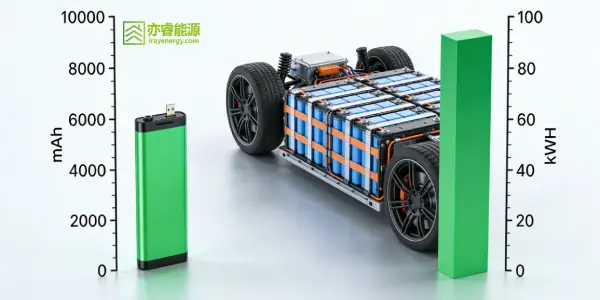
The C-rate of a battery is essentially an indicator used to describe how fast a battery is charged or discharged. It represents the rate at which a battery completes charging or discharging within a specified period of time. It is important to note that C-rate is not a unit of capacity (the differences between battery capacity units are explained in detail in the previous article “mAh and kWh Both Measure Battery Capacity—What’s the Difference?” and will not be repeated here). Instead, C-rate is a dimensionless ratio that reflects “how much current the battery is charged or discharged with, and over how long a time.”
For this reason, even if two batteries have the same capacity, different C-rate designs will lead to significant differences in charging time, discharge capability, and suitable application scenarios.
In practical applications, C-rate is usually divided into charge C-rate and discharge C-rate. A higher charge C-rate means the battery can be charged with a larger current, shortening the charging time—what we commonly refer to as fast charging. However, this also accelerates internal electrochemical reactions and leads to higher temperature rise. If the charging rate exceeds the battery’s design limit, it may damage electrode materials, electrolyte, or internal structure, thereby reducing service life and even causing safety risks.
The discharge C-rate mainly reflects the battery’s output capability. A high discharge rate means the battery must deliver a large current in a short time. Under such conditions, voltage drop caused by internal resistance becomes more pronounced, terminal voltage falls faster, and energy losses increase. Long-term operation at high discharge C-rates will likewise have a negative impact on battery lifespan.
2、How Is C-Rate Calculated?
From a calculation perspective, C-rate is not complicated. The most common method in daily work is to estimate it using current and capacity: C-rate = charge or discharge current ÷ battery capacity.
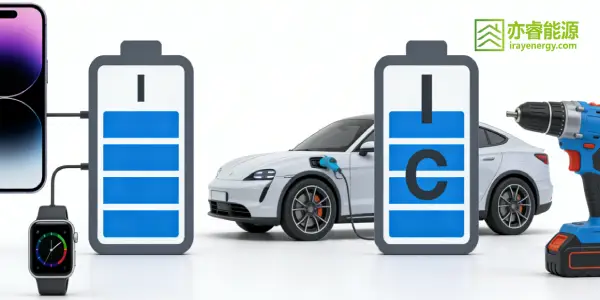
For example, if a battery has a rated capacity of 20 Ah and the charging current is 10 A, the corresponding charge C-rate is 0.5C. This calculation method is very common in the consumer electronics field and is often used to roughly judge the charging and discharging characteristics of products such as smartphones and wearables. It is worth noting that in many modern consumer electronic devices, charging speed is already significantly faster than discharging speed, meaning that the charge C-rate is often higher than the discharge C-rate.
In the energy storage field, C-rate is more commonly judged through power and energy. For instance, if an energy storage project has a scale of 100 MW / 200 MWh, the ratio of power to energy directly indicates that the system’s C-rate is approximately 0.5C. Although this is an engineering simplification, it is very intuitive and practical for solution comparison and project communication. Strictly speaking, however, the actual charge and discharge C-rates of a battery system are not necessarily identical; they are influenced by battery chemistry, structural design, and specific application conditions.
3、C-Rate Characteristics in Different Application Scenarios
Different application scenarios have very different requirements for battery C-rate. Taking energy storage batteries as an example, these systems usually have relatively sufficient charging time and focus more on cycle life and overall cost. Therefore, their charge C-rates are generally low, typically in the range of 0.2C to 0.5C. The commonly seen 0.25C and 0.5C energy storage projects in recent years are a direct reflection of this approach.
On the discharge side, if the energy storage system is mainly used for grid power smoothing, the discharge C-rate is usually around 0.5C to 1C. If it is used for emergency power supply or backup power, it may need to output higher power in a short time, pushing the discharge C-rate to 1C or even 2C.
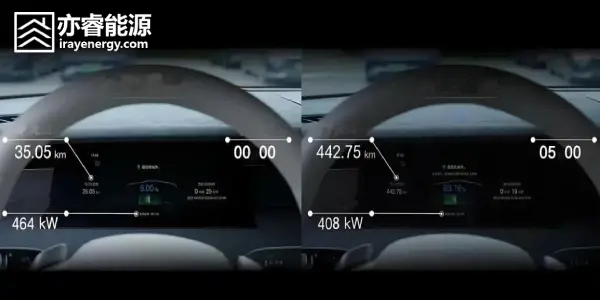
Power batteries present a very different picture. To shorten charging time and improve user experience, electric vehicles place much higher demands on charge C-rate in fast-charging scenarios. Some fast-charging technologies can achieve charge rates of 2C, 3C, or even higher.
At the same time, during acceleration, climbing, and other driving conditions, the battery must continuously deliver high power, so discharge C-rates are typically in the range of 3C to 5C. High-performance batteries may even involve discharge capabilities at the 10C level, which poses much greater challenges to battery material systems and structural design.
Summary
Overall, C-rate is not an abstract or complicated concept. It reflects the “speed and intensity” of a battery during charging and discharging. Once you understand the relationship between C-rate and current, capacity, and power, and then combine this understanding with specific application scenarios, many battery parameters can be roughly positioned at a glance. For professionals in the battery industry, truly understanding C-rate is the foundation for correctly interpreting specifications, making sound designs, and avoiding misjudgments.